

Logo Design, Branding, & Squarespace Website Design for a Public Impact Firm — Linda Vista Communications
Linda Vista Communications is a Pasadena-based communications partnership that works with nonprofits, research institutions, and public-impact organizations. The partners are seasoned leaders in the nonprofit and academic worlds, using communication as a tool for social impact.
They approached me to create a cohesive visual identity and a fully designed Squarespace website that would reflect their expertise, their Pasadena roots, and their commitment to clear, precise communication.
Client: Linda Vista Communications
Services: Branding and Website Design
Deliverables: Logo design, Brand style guide, Website Copy Refinement, Website Design & Development in Squarespace
Background & Problem
The partners had assembled a basic Squarespace website themselves and were using it as a placeholder. While it contained the right content structure — About, Services, Contact — it lacked a coherent visual identity and professional presentation. They did not have:
A professional logo design
A consistent color and type system
A website experience that felt intentional, polished, and aligned with their story
They wanted something simple, honest, and professional — not a glitzy, lifestyle-oriented PR look. The challenge was to design a small but highly intentional brand and website that:
Spoke clearly to nonprofit, academic, and policy audiences
Visually grounded the firm in Pasadena and the Linda Vista area
Could grow with them as they added collaborators, testimonials, and more content
Read deeper into the details behind every design decision.
-
1. Discovery Meeting
We started with a discovery meeting where I listened to:
Their personal stories and professional backgrounds
Their motivations for starting Linda Vista Communications
Their aspirations for the brand and how they want to be perceived
We also clarified the scope and objectives:
Develop a brand identity: logo/wordmark, visual system, style guide
Design and develop a Squarespace website that feels clear, focused, and rooted in Pasadena
Keep the initial site simple, content-light, and future-ready (with room for more collaborators and testimonials later)
This conversation also helped us define key tone words: clean, clear, sharp, local.
2. Research
Next, I conducted visual and contextual research on Pasadena and Linda Vista:
I explored the geography and history of Pasadena, taking virtual tours of the area.
I studied its tall trees, mountain backdrop, foothills, light, and craftsman architecture — elements that locals recognize instantly.
Because place is central to Linda Vista’s story, it was important for me to understand it visually and emotionally, not just as a name. This research informed:
The landscape-driven logo concepts
The color direction (greens, blues, earth tones)
The later decisions on photography and gradients for the website
I wanted the audience — especially local Pasadena organizations — to feel an immediate, subtle recognition through familiar geographic cues.
3. Strategy
From discovery and contextual research, I built the brand direction on four principles:
Communications-first design
Typography, spacing, and hierarchy were treated as strategic tools to facilitate clarity and ease of reading — reflecting the firm’s identity as precise communicators. Clarity as positioning.
Place as Differentiator
Anchor the brand in Pasadena / Linda Vista through landscape references: trees, valley, mountains, sky.
Avoid generic “LA glitz” and cliché visuals.
Clean, clear, sharp
Honor the client’s words: they wanted a design that feels clean, clear, sharp.
Limit decorative noise; every element must serve the message.
Simple now, scalable later
Build a small, focused website and system for launch.
A limited color system and intentional layout choices reinforce confidence and professionalism.
Design structure and patterns that can easily accommodate more content, case studies, and collaborators later.
-
Objectives for the Logo
We established clear objectives for the logo phase:
Create a logo design that reflects the firm’s:
Focus on clear communication
Connection to Pasadena’s inspiring landscape
Develop a system that works:
On the website
On business cards and letterhead
In small formats (LinkedIn, social avatars, etc.)
Keywords That Guided the Concepts
From our discovery work, a few keywords became anchors for the logo direction:
Clear
Inspired by the brand’s messaging around “clean, clear, sharp” communication.
Communication
The firm’s core service and identity.
Landscape
Pasadena as valley + mountains + tall trees that guide your eye upward to the sky.
These words helped keep the concepts grounded in who they are, what they do, and where they are.
Concept Presentation Process
I always present clients with two logo concepts:
Concept A – The “expected” or safer direction
Aligns closely with the client’s industry expectations.
Meets all objectives in a familiar, comfortable way.
Concept B – The “stretch” direction
Still aligned with the brief, but more creatively expressive.
Often speaks more boldly to their aspirations or a deeper layer of their story.
Because we had done thorough discovery and confirmed strategy, both directions were clearly on-brief — but each emphasized a different nuance of the brand.
Concept A – “Clarity in the Details”
Concept description:
Sharp, clean calligraphic strokes reflect the bright morning sun as it shines above the landscape.*This direction:
Focused on refined, calligraphic line work and sharp details.
Emphasized the firm’s ability to move from fine print to big-picture clarity.
Invited closer inspection: the more you look, the more satisfying the details become.
Concept A speaks to Linda Vista’s role in discerning critical details and guiding clients through complex moments with clarity — just as you might appreciate the Pasadena landscape more deeply the longer you look at it.
Concept B – “Sound Across the Landscape”
Concept description:
The beautiful sound of the words “Linda Vista” resonates throughout the landscape, as the sun rises.*This direction:
Was slightly more expressive and poetic.
Highlighted how “Linda Vista” sounds as well as how it sits in the Pasadena landscape.
Visually referenced mountains, valleys, and trees, the quintessential elements of Pasadena’s viewpoint.
The composition was designed to:
Lead the eye toward a single point of focus, reinforcing clarity.
Suggest that the brand helps illuminate context and understanding, much like a rising sun that reveals the landscape.
The Asterisk: A Key Symbol
A central element in both concept directions was the asterisk.
In written language, an asterisk:
Draws attention to important context without interrupting the main message.
Acts as a footnote marker, guiding the reader to deeper or clarifying information.
For Linda Vista, the asterisk symbolizes the firm’s role as a guide — helping meaning emerge clearly and thoughtfully by adding context, nuance, and explanation.
The asterisk also carries a poetic, visual meaning:
Its star-like form echoes a rising sun.
Just as morning light gradually reveals the landscape, the asterisk suggests revelation, the moment when meaning becomes clearer, and when a message fully resonates.
This dual meaning positions the asterisk as a bridge between information and interpretation. It embodies Linda Vista’s belief that effective communication is not just about transmitting information, but about illuminating context, intention, and understanding.
Color Choices
The color palette draws from:
Tall green trees, foothills, and natural elements of Pasadena
Soft blues of the sky
Neutral tones to keep the overall feel clean and grounded
In practice:
I prioritized one of the greens as the primary accent color, aligning with the brand promise of “clean, clear, sharp” design.
I tested using blue as a secondary highlight for calls-to-action or secondary content, but found that it made layouts feel unnecessarily busy and it visually competed with the clarity we were trying to emphasize.
Given the current amount of content, keeping the palette restrained supported the brand’s goals better. However, there could be future opportunities to extend the color system:
As they add case studies, blog posts, or more in-depth content, additional colors could help differentiate sections, categories, or content types without over-complicating the experience.
Client Feedback & Final Direction
The clients responded very positively to both concepts and appreciated the thinking behind them. Ultimately, they chose Concept B as the primary direction while asking for a typographic refinement to “communications” in Concept B.
From there, I completed the revision request:
Refined the weight and hierarchy of “communications” in Concept B.
Preserved the poetic landscape and asterisk story, while improving legibility and balance.
-
The clients provided thoughtful, clear copy that already communicated:
Who they are
What they do
Why their work matters
Their voice was naturally direct and precise, which aligned with our brand objectives. My role was to:
Refine and structure the copy across the four key pages (Homepage, About, Services, Contact).
Make the visitor journey more linear and easy to follow.
I focused on:
Clarifying headlines and subheads so visitors can quickly scan.
Ensuring that each page has a clear purpose and call-to-action.
Keeping the tone consistent with the “clean, clear, sharp” design direction.
-
Figma Prototype
Before building in Squarespace, I created a full website design prototype in Figma for all four pages:
Homepage – positioning, hero, overview of services, and path to contact
About – story of the partners, their background, and Pasadena context
Services – how they help nonprofits, research/academic clients, and public-impact organizations
Contact – simple, direct invitation to start a conversation
In Figma, I:
Established visual hierarchy and rhythm using type scales, spacing, and section layout.
Integrated the logo, asterisk motif, and color palette.
Explored the role of gradients and landscape references in hero and sectional imagery.
I then presented a walkthrough of the prototype to the clients, explaining:
How the layout supports their visitor journey
How each design decision (color, type, imagery) ties back to our objectives
How the site maintains simplicity while feeling distinct and intentional
They were happy with the overall design and requested only minor refinements, so we moved forward to development.
Development in Squarespace
With the Figma prototype approved, I translated the design into a live Squarespace site:
Defined the information architecture and navigation.
Implemented typography, color, and spacing via Squarespace’s design settings — effectively turning the site into a living style guide.
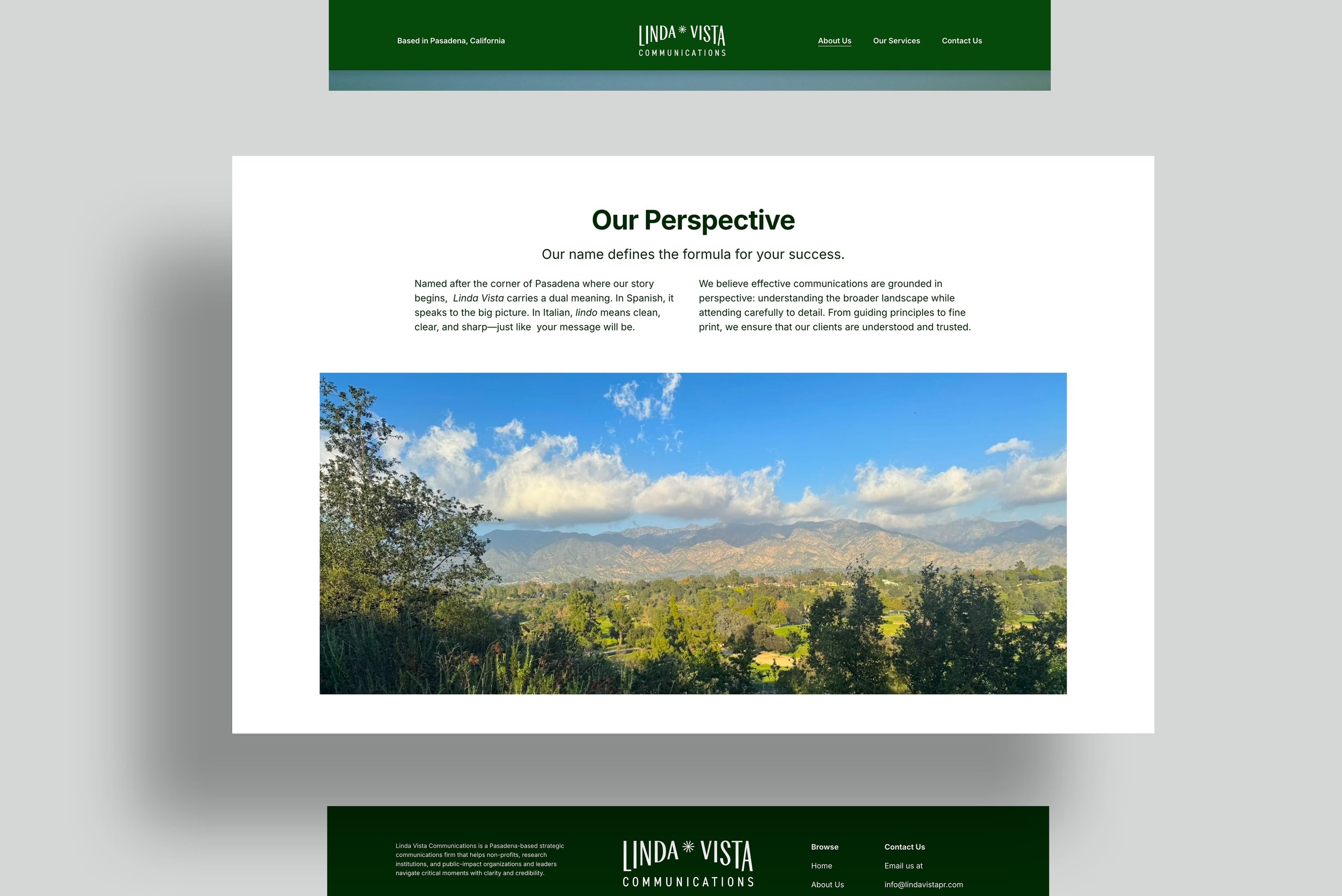
Integrated authentic imagery of Linda Vista and Pasadena, using higher-resolution photos supplied by the client and planning for future photography.
The resulting website:
Clearly communicates who they are, what they do, and for whom.
Makes it easy for visitors to understand their expertise and get in touch.
Feels simple, focused, and professional — true to their context and values.

Before & After
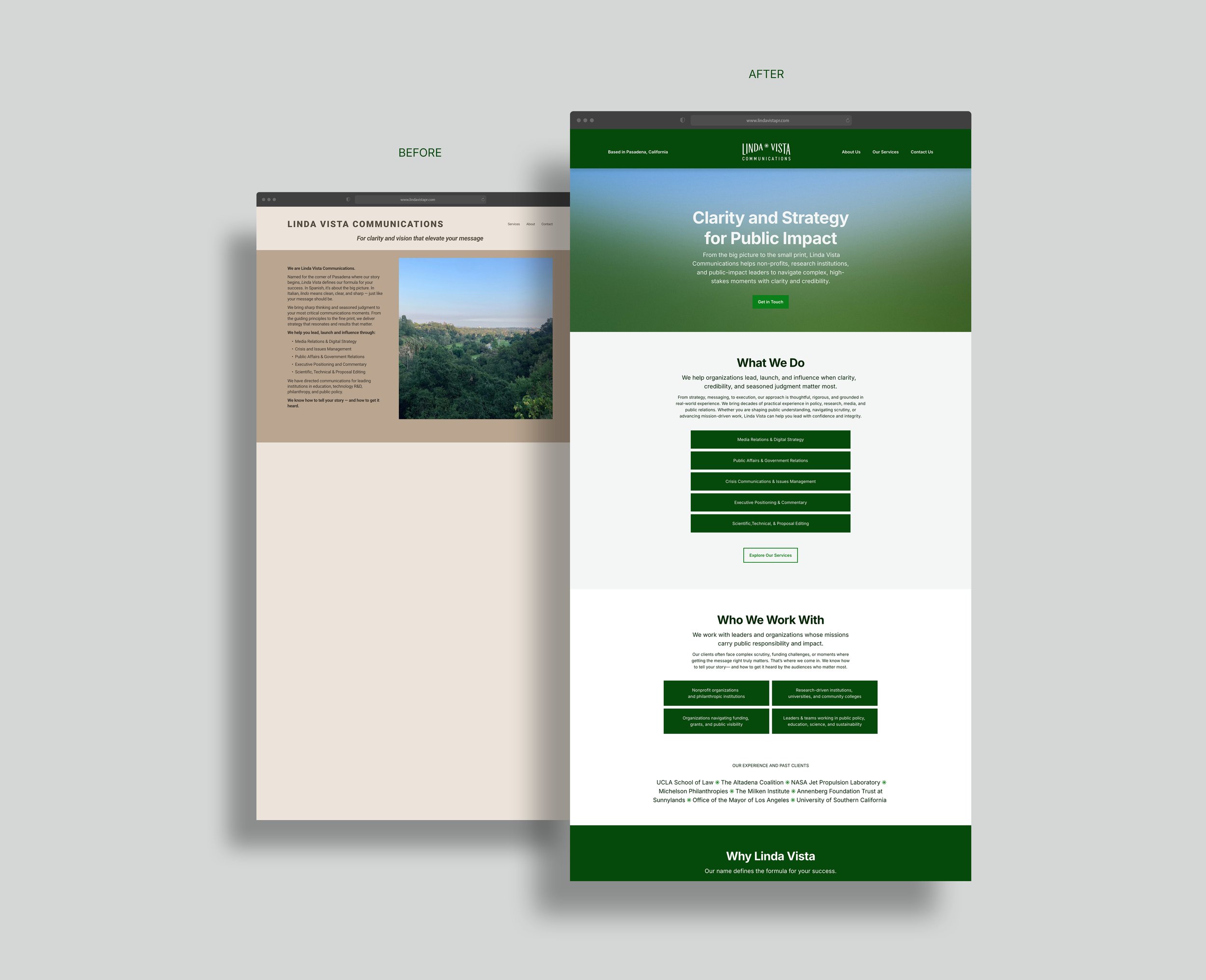
Before:
A self-assembled Squarespace site with:
Inconsistent typography
Pixelated images
No cohesive visual system or logo
After:
A branded Squarespace site with:
A considered logo and asterisk system
A restrained, landscape-inspired color palette
Clear hierarchy and page structure
Copy and layout aligned to their visitor journey
Results & Impact
The new brand and website now:
Tell a unique story tied closely to Pasadena and Linda Vista’s landscape.
Present a refined, clear, and sharp digital presence that matches their expertise.
Make it easy for visitors — nonprofits, research institutions, policy organizations — to understand:
What Linda Vista Communications offers
How they think
How to get in touch
They now stand out from competitors with a brand that:
Speaks directly to their story and context
Communicates with precision to the right people
Feels distinctive, without resorting to clichés or generic visuals
Reflection
This project highlighted the value of making every design decision answer back to the core objectives: clean, clear, sharp communication rooted in place.
On Color & Simplicity
We discussed adding blue to the color palette. I experimented with multiple different applications — especially using blue for secondary CTAs and content. On review, these treatments felt visually busier than necessary and somewhat misaligned with the desired calm, precise clarity.
Given the limited content at launch, a more restrained palette — centered on greens and neutrals — better supported our goals. I see room to expand the color system later as Linda Vista adds richer content such as case studies and thought leadership.
On Imagery
As a newer business, Linda Vista had a limited image library to draw from at the time of launch. To work within this constraint while still building visual warmth and credibility, I recommended incorporating more people-focused photography in future iterations. Human imagery would help the brand feel more approachable and relatable — reinforcing the consultancy's personal, place-rooted approach while reducing any risk of the site reading as too abstract or minimal.
On Gradients & Future Opportunities
One element I would like to explore further is expanding the use of gradients inspired by Linda Vista’s light and landscape:
Gradients can capture the transition of light across the hills and trees — a more abstract yet still site-specific expression of place.
The concern, in a brand so focused on clarity, is that gradients might be perceived as too abstract or decorative.
However, if handled thoughtfully, gradients can be framed as a visual metaphor for clarity emerging:
From darker to lighter tones, they can represent the process of moving from complexity to understanding.
Paired with the asterisk symbol, gradients can support the idea of illumination — the moment when a message finally lands and the context becomes clear.
The client expressed wanting to avoid being confused for a landscaping company due to the landscape photos and the green brand colors. The solution of using more gradients would help the client stand out and avoid this possible association.
In future iterations, I see a strong opportunity to:
Use gradient treatments as backgrounds for key sections or quote blocks
Tie them explicitly to Pasadena’s sky and landscape at different times of day
Make a connection to their approach strategy in way that speaks to the audience
This design element would add a great boost to the brand’s positioning: differentiating Linda Vista from competitors who rely on cliché stock photography, while remaining faithful to the brand’s focus on clarity and place.
As the brand and business grow, these gradient-based elements — and an expanded color system — could become powerful tools for storytelling across new content types.
On the Contact Form
Another area I would improve is the contact form. Currently it is minimal, which suits the launch stage, but there is an opportunity to make it work harder as a qualifying and insights tool. I would add a service selection option so visitors can indicate what they’re looking for from the outset, streamlining the intake process. I would also include a field asking how the visitor found Linda Vista, whether through a referral, search, social media, or another channel. This kind of data would be immediately valuable for a growing business, helping Linda Vista understand where their audience is coming from and where to invest in outreach.
Looking Ahead
As the brand and business grow, these improvements — richer photography, expanded gradients, a more intelligent contact form, and an expanded color system — could become powerful tools for storytelling across new content types.